

THE ROOF
IS LEAKING
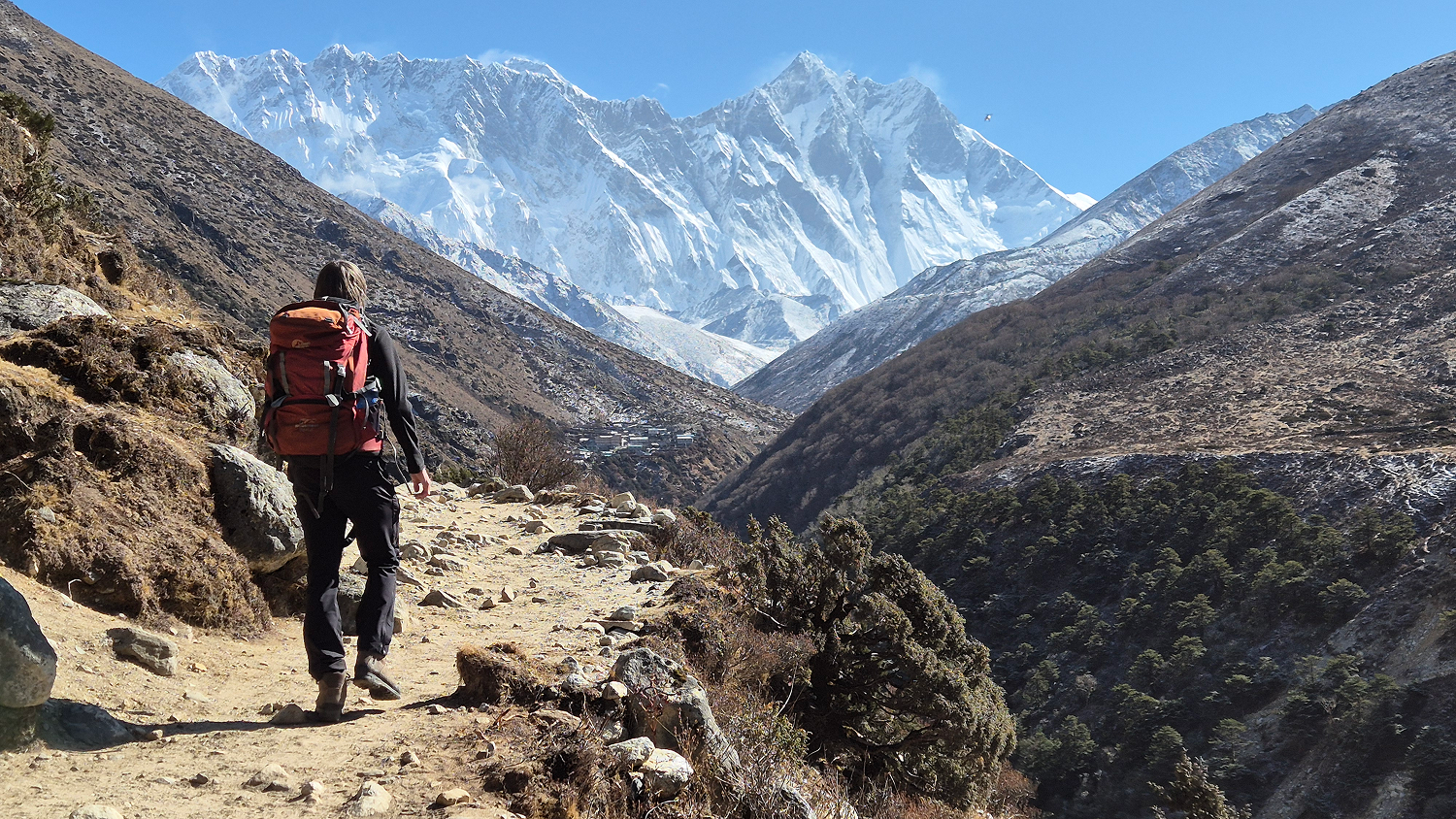

Researchers have scaled new heights to show how climate change affects even the remotest areas of the planet. A team led by Professor Duncan Quincey travelled to the roof of the world to examine changing temperatures in the vast Khumbu Glacier, just below Mount Everest.
It was an arduous journey: “We were in Nepal for six weeks. Much of that time was spent trekking to base camp, then we climbed for another six days to 6,680 metres, about 2,000 metres below the summit. Base camp is well serviced with lodges and good accommodation, but beyond that point, above camp two, there’s very little.”
Their team carried heavy loads: “On previous trips lower down the mountain, the equipment came in by helicopter, but at these altitudes the air is too thin for them to fly safely. Instead we had a team of Sherpa to help carry what we needed up to the drill site.”
They drilled 12 metres into the firn, the intermediate layer between snow and ice, installing sensors in two boreholes. These take temperature readings every half an hour – which now come into Duncan’s inbox early every morning: “Checking the readings is the first thing I do every day.”
They reveal a glacier under real threat. “We showed previously that the ice is just a few degrees below zero. We now see that the surface ice is melting even when the air temperature is as low as minus 10, and we think it’s due to the sun’s radiation. Existing models of what will happen to the glacier in the years ahead don’t account for this process, so our projections are probably inaccurate.”
It’s a critical issue. “People downstream rely on a steady flow of water from the glacier for irrigation, drinking water and sanitation – and local ecosystems depend on it too. The faster it melts, the greater the risk of flooding, and the earlier this essential resource will expire.
“Hopefully our findings will support local people by giving them a better idea of how long the glaciers will be around, and allow them to prepare for the future.”
Hear more about Duncan’s expedition and the work that the University is doing to help protect communities at risk in a special episode of the 'How To Fix...' research podcast, starring Leeds alum and renowned mountaineer Kenton Cool (Earth Sciences 1994, Hon DLitt 2018).
 Built with Shorthand